O-1 Visa and talent visas
O-1 Petitioner - O-1 for RU/BY - EB-1A Awards - EB-2 NIW guide - Success stories - Filing fee
Frequent question: USCIS approved an O-1 petition for 3 years, but the visa stamp in the passport was issued for a shorter period. Why? If you are just starting to learn the topic, it’s useful to first understand who files an O-1 petition and how the agent scheme works.
Short version:
Russia (RU) - the O-1 visa is stamped for up to 24 months (2 years).
Belarus - the O-1 visa is stamped for up to 12 months (1 year).
This is not the same as the period of status. O-1 status is approved by USCIS for up to 3 years.
You may stay in the U.S. according to your I-94 (period of admission), not the date on the visa.
O-1 visa for citizens of Russia and Belarus: periods and rules
Main article on the topic: O-1 visa: requirements
This is the main source of confusion. In the U.S. immigration system there are three concepts that are often mixed up:
| What | What it determines | Who issues it | Where to check |
|---|---|---|---|
| Visa stamp | Until what date you can enter the U.S. | Consulate | Sticker in the passport |
| Status (I-797) | For what period the petition / work authorization is approved | USCIS | I-797 Approval Notice |
| I-94 | Until what date you can remain in the U.S. | CBP (customs at entry) | i94.cbp.dhs.gov |
A visa can expire while you are in the U.S., and that is normal. The visa is needed only for entry. If you are inside the country and your I-94 / status is valid, an expired visa is not a violation. A new stamp can be obtained only outside the U.S., at a consulate.
Period of O-1 status (USCIS approval)
USCIS approves an O-1 petition for up to 3 years (initial period of stay). Extensions are in 1-year increments. More about what happens to O-1 status if you are fired.
Period of the visa stamp (consulate)
The visa validity period is determined not by USCIS but by the Department of State’s Reciprocity Schedule — bilateral agreements between the U.S. and each country. For citizens of different countries the periods differ:
| Nationality | O-1 visa | Number of entries | Consular fee |
|---|---|---|---|
| Russia (RU) | 24 months (2 years) | Multiple | None |
| Belarus | 12 months (1 year) | Multiple | None |
The visa stamp’s validity cannot exceed the approved petition period (I-797) or the maximum in the reciprocity schedule — the shorter of the two applies.
The same limits apply to other visa categories. For Russian citizens per the reciprocity schedule: B-1/B-2 - 36 months, H-1B - 24 months, L-1 - 24 months. For Belarusian citizens the periods are even shorter. Full tables for all categories: RU | BY.
O-1 visa is issued to Russians for 2 years (24 months)
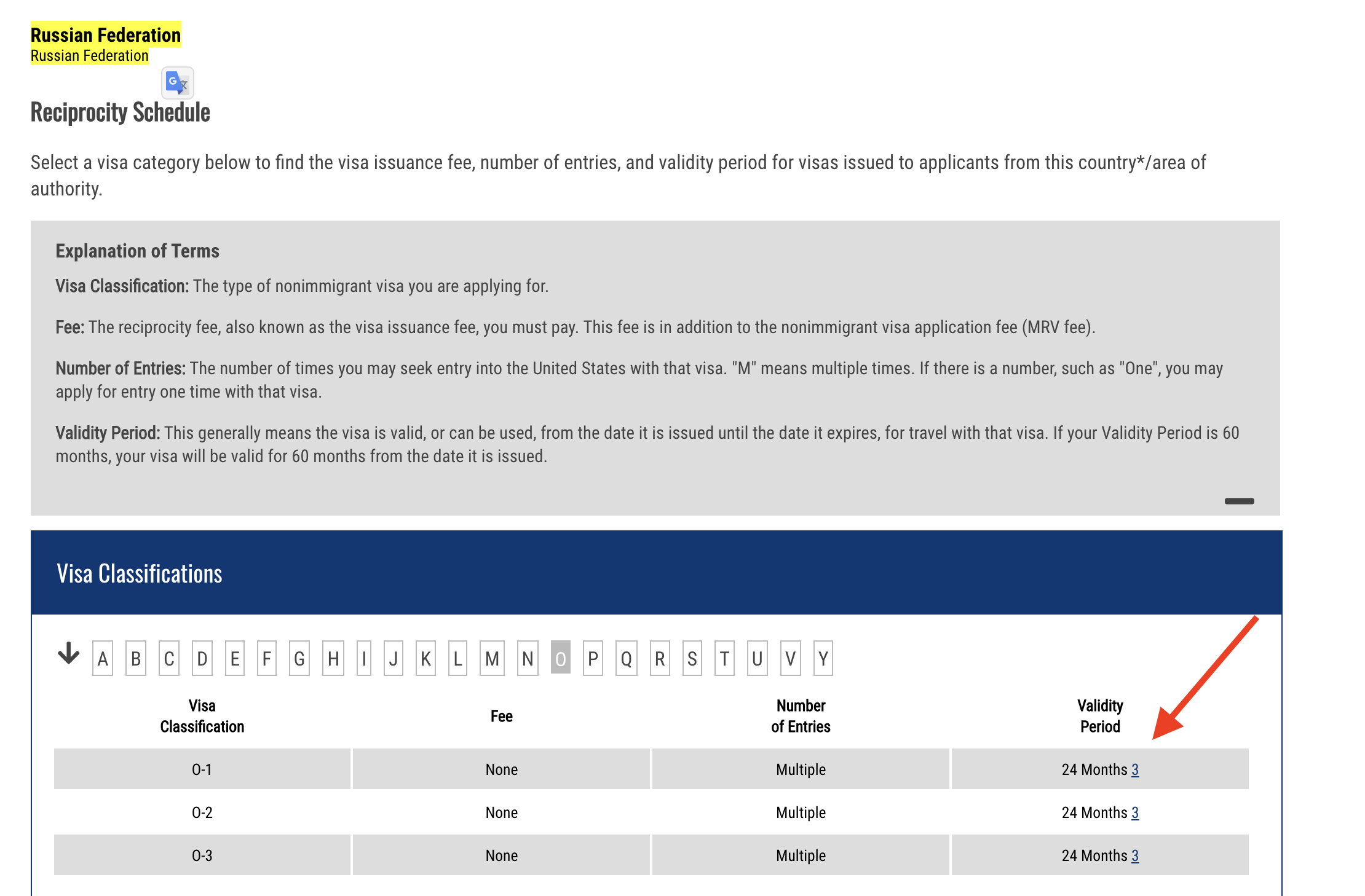
Reciprocity Schedule for RU: O-1 - 24 months, multiple entry. Source: travel.state.gov
Even if USCIS approved the petition for 3 years, the consulate will stamp the visa for a maximum of 2 years. There is a separate breakdown about the consular interview process.
Unfortunately, Belarusian citizens receive the O-1 visa for only 12 months
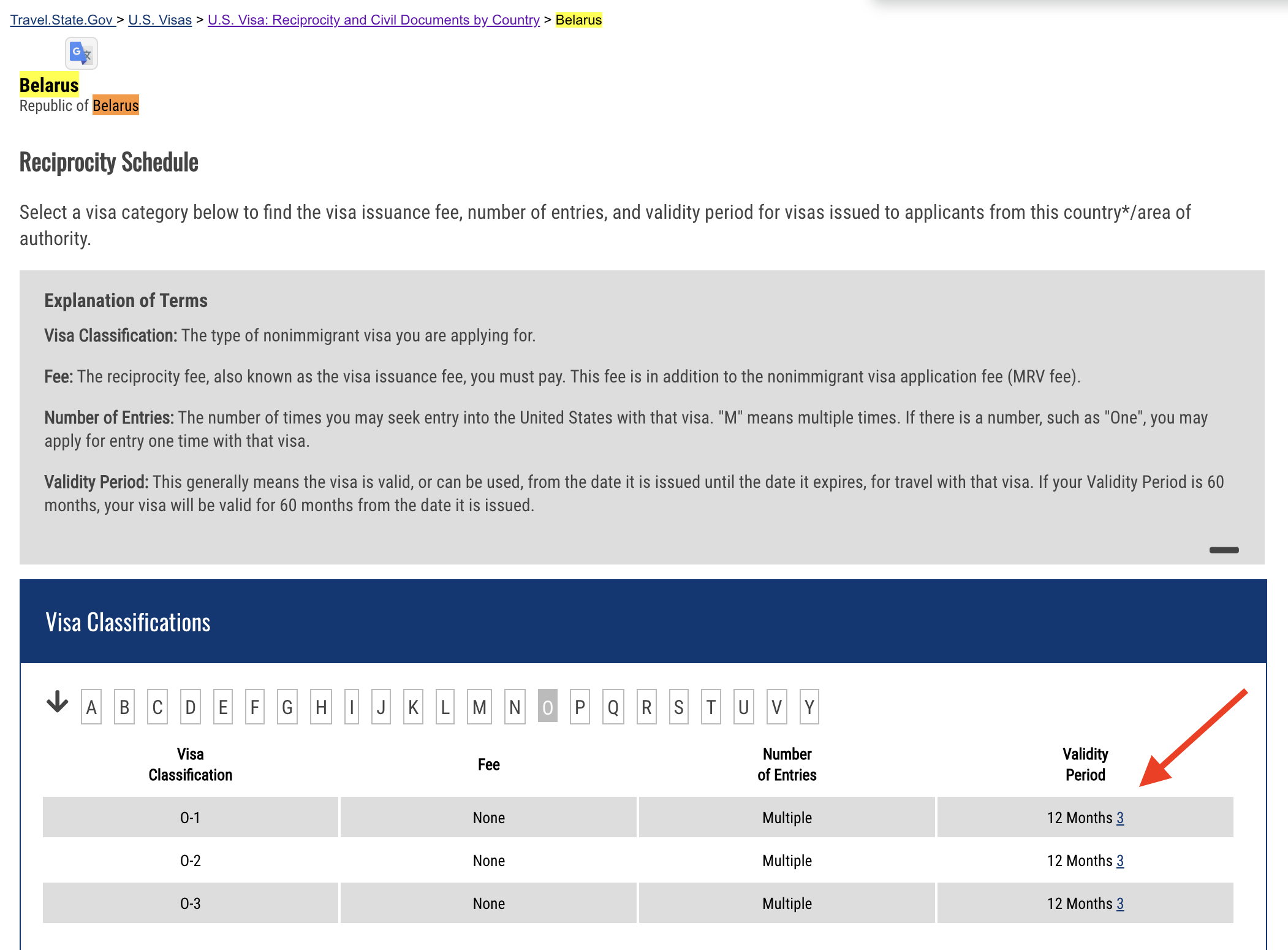
Reciprocity Schedule for Belarus: O-1 - 12 months, multiple entry. Source: travel.state.gov
Belarusian citizens get an O-1 visa stamped for 1 year. With a three-year petition you will need to re-stamp the visa twice.
Visa re-stamping: how it works
Two rules that are important not to confuse:
- You may remain in the U.S. with an expired visa if your status (I-94) is valid. An expired visa while inside the country is not a violation. Working is also allowed — work authorization is tied to status, not the visa.
- A new visa stamp is obtained only outside the U.S., at a consulate. You cannot re-stamp inside the U.S. (the domestic visa renewal program currently covers only H-1B and L-1; O-1 is not included). If you left and your visa expired — you need a new stamp before returning.
In practice this means: if you do not plan to leave the U.S. before the petition ends, you do not need to re-stamp. If you plan trips, monitor the visa expiration date.
Approval received, you are outside the U.S. What next?
Above — answer to the main question about the visa stamp period. Below — an extended practical guide: the whole path from petition approval to entry into the U.S.
-
Wait for the I-797 (Notice of Approval). I-797 is a paper document USCIS mails after petition approval. It is needed for the interview and at entry. USCIS sends it to the petitioner (employer or agent) in the U.S., who forwards a copy or scan to you. The original usually stays with the petitioner. A copy or scan is usually sufficient for the interview, but specific post requirements should be checked. Delivery can take 2–4 weeks (with premium processing the petition is adjudicated within 15 days). Track the case: USCIS Case Status. Current processing times: USCIS Processing Times
-
Complete DS-160 - the online visa application form. Filled electronically at ceac.state.gov. The form includes personal data, travel history, work information. After completion save the confirmation page with barcode — print and bring it to the interview. Instructions: Department of State site
-
Pay the consular fee (MRV fee) - $205 for O category. The fee is for application processing and is non-refundable even if denied. For RU and BY citizens there is no additional reciprocity fee for O-1 (see table above). Payment: ustraveldocs.com
-
Choose a consulate and schedule the interview. Since September 2025 the Department of State restricted filings in third countries. Previously you could book at any consulate worldwide; now only in the country of citizenship or residence (by passport or residence permit). For Russian citizens the Department of State assigned: Astana (Kazakhstan) and Warsaw (Poland). For Belarusian citizens: Vilnius (Lithuania) and Warsaw (Poland). If you have a residence permit of another country — you may apply there. Full list of assigned consulates: DOS page. Find the U.S. embassy or consulate in the country you need: usembassy.gov. Schedule an interview: ustraveldocs.com. Consulate wait times: DOS wait times. Consider the current situation with the suspension of visas for certain countries. Forum overview: 11 consulates by country
-
No medical exam is required for O-1. Unlike immigrant visas (EB-1A, EB-2 NIW), the nonimmigrant O-1 visa does not require a medical exam (I-693). A medical exam will be needed later if you apply for a green card.
-
Gather documents for the interview:
- Passport (valid at least 6 months beyond planned entry)
- I-797 Approval Notice (copy; original usually with petitioner)
- DS-160 confirmation page (printed)
- Photo per DOS requirements (2x2 inches / 5x5 cm, white background). If you are applying concurrently for a green card, photo requirements differ — see photo for green card: 9 mistakes
- Proof of MRV fee payment
- Petition and supporting documents (recommendation letters, CV, contract) — in case the officer asks
- If applying based on residence permit (not citizenship): residence permit / permesso di soggiorno / proof of lawful residence in the country of application
- If applying with a second passport: both passports
Detailed breakdown
-
Attend the interview. The consular officer verifies whether you correspond to the approved petition. For O-1 the interview is usually short — the petition is already approved by USCIS. They may ask: what you do, who the employer is, what achievements you have. Real stories: consular interview – 10+ stories
-
Possible interview outcomes — there are three:
a) Visa approved. Passport is retained for 1–5 days for the visa to be stamped.
b) Refusal under Section 214(b). The most common denial for nonimmigrant visas. Section 214(b) of the Immigration and Nationality Act (INA) presumes immigrant intent: every applicant is considered a potential immigrant until proven otherwise. In simple terms, the officer was not convinced you will return from the U.S. For O-1 this is rare (the petition is already approved by USCIS) but it happens. A 214(b) refusal is not final. There is no mandatory waiting period to reapply — you may reapply at any time. But it will be a new application, not a reconsideration — you must complete a new DS-160, repay the consular fee ($205) and schedule a new interview. Practically, reapplying makes sense when new evidence exists or circumstances have substantially changed.
c) Administrative processing under Section 221(g). This is not a refusal, and the logic differs from 214(b). Section 221(g) of the INA allows the consulate to suspend visa issuance for additional review. The visa is not issued, but it is not refused. The case is sent for review to Washington. You are given a colored slip and asked to wait. Often you can simply submit the requested documents without repaying if you meet the deadline provided by the consulate.
What to know about administrative processing:
- It’s a security check. For RU and BY citizens, especially in technical fields (IT, engineering, science, biotech), it is assigned very frequently
- It may include checks like MANTIS (technology control) or completing an additional DS-5535 form
- Timelines for O-1 for RU/BY citizens: from several weeks to a year or more. There are no standard times — it depends on specialty, country of application and current workload. Real statistics on processing times by consulate
- The passport may remain at the consulate during this time (some posts return it temporarily — depends on the consulate)
- Check status: ceac.state.gov
- If the check drags on for many months — there are pressure options: mandamus and contacting Congress
- Detailed breakdown: administrative processing 221(g) — what it is and what to do
-
Receive passport with the visa. The consulate will stamp the visa sticker. Period: for Russian citizens — up to 24 months, for BY — up to 12 months (but not exceeding the petition period). The passport is returned by courier or you pick it up — depends on the consulate
-
Entry to the U.S. At the border a CBP officer will check your passport, visa and I-797. The I-94 record is created in the system — this is your official period of admission. You may enter up to 10 days before the petition start date.
What to check after entry
Immediately after passport control check your I-94 record:
- Go to i94.cbp.dhs.gov and enter passport details
- Check the Class of Admission — it should be O-1 (not B-1, not WT, not another class)
- Check the Admit Until Date — it should not be cut earlier than the approved petition end date. Per 8 CFR 214.2(o)(6)(iii) an O-1 may be admitted for the petition period plus up to 10 days after, so the I-94 date may not always match the I-797 day-for-day — this is normal. The main thing is that it’s not earlier than the petition end date
- Save a PDF or screenshot — you’ll need it for your employer, getting an SSN, driver’s license
- If CBP placed the wrong status or date — correct it via a CBP correction request as soon as possible. Don’t postpone — errors in the I-94 cause problems with employers and when extending
10 days before and after the petition
Under 8 CFR 214.2(o)(6)(iii), an O-1 holder may:
-
Enter the U.S. up to 10 days before the petition start date. You cannot work during these days — only settle in, find housing, open a bank account
-
Remain in the U.S. up to 10 days after the petition end date. These days are for packing and departure. You cannot work either
-
If you do not leave after the authorized period per I-94 and did not file an extension or change of status — the situation becomes serious. It’s important to distinguish two concepts:
- Out of status — you are no longer in lawful immigration status
- Unlawful presence — begins to accrue after the authorized period of stay ends, and it is unlawful presence that triggers reentry bars: 180+ days = 3-year bar, 365+ days = 10-year bar
Important nuance: if you timely filed an extension (I-129 for O-1) or change of status (I-539) before the I-94 expiry, you are in a period of authorized stay and unlawful presence does not accrue while the application is pending. If you didn’t file on time — consult an attorney; consequences depend on circumstances
Family: O-3 for spouse and children
Spouse and unmarried children under 21 may receive O-3 visas (derivative status) under 8 CFR 214.2(o). What to know:
- Each family member fills out a separate DS-160 and attends a separate interview (usually together with the principal applicant)
- Required: passport, marriage / birth certificate (with translation), copy of the principal applicant’s I-797
- The O-3 visa period is tied to the principal applicant’s O-1 visa — it cannot exceed it
- Reciprocity schedule applies by each family member’s citizenship. If the spouse has a different nationality, the visa period may differ. Check: reciprocity schedule
- O-3 holders cannot work in the U.S. Unlike H-4, O-3 does not have eligibility for EAD (work authorization). O-3 is not in the list of categories eligible for EAD
- Children may study (school, university) without changing status
- O-3 applicants are evaluated under the same intent standards as the principal O-1. The spouse does not need to prove “ties to home” as with B or F visas
Changing employer / agent / new petition
If you change employers, the new employer must file a new O-1 petition (Form I-129) with USCIS. Unlike H-1B, O-1 does not have portability — you cannot start working for the new employer until the new petition is approved (see USCIS Policy Manual, Volume 2, Part M).
A frequent question: can you enter on a visa stamped based on the old petition?
- The visa stamp is tied to the classification (O-1), not a specific employer. The visa shows the petitioner’s name, but CBP allows entry with a valid visa + a new I-797
- In practice, if you have a valid O-1 visa and a newly approved petition (new I-797), you can enter
- Bring both I-797s (old and new), a letter from the new employer, and a copy of the new petition. CBP may ask questions
- If in doubt — safer to re-stamp the visa based on the new petition
Second passport, residence permit and choice of consulate
For the RU/BY audience this is a common case — many have a second citizenship or residence permit.
- Reciprocity schedule is determined by citizenship (the passport you present), not by the place of filing. If you apply with a RU passport — the O-1 visa will be 24 months even if you apply in Warsaw. If you apply with an Israeli passport — Israeli reciprocity applies. Check reciprocity for any country: travel.state.gov
- Where to apply: per the 2025 rules — in the country of citizenship or residence. If you have an Italian residence permit, you can apply in Italy (by residency). If you have a second Israeli passport, you can apply in Israel (by citizenship)
- The visa is stamped in the passport you use to apply. When entering you must present the passport with the visa + the corresponding I-797 +, if necessary, the second valid passport. A visa in an Israeli passport won’t work if you present a Russian passport
- Two passports of the same country (old + new): if the visa is in the old passport you can travel with both. CBP will stamp VIOPP (visa in other passport) in the new one on entry. More: DOS FAQ
Frequently asked questions
USCIS approved for 3 years, but the visa was issued for 1–2 years. Is that normal?
Yes. The visa period is determined by the reciprocity schedule by citizenship, not by the petition period. For RU the maximum is 24 months, for BY — 12 months. You may remain in the U.S. for the entire petition period per I-94.
Why was the visa issued for less than 24 (or 12) months?
24 and 12 months are maxima per the reciprocity schedule. The consulate will stamp a shorter period if the petition ends earlier (the shorter of the two is used). For example: if the petition was approved for the remaining 18 months, the visa will be issued for 18, not 24. There are also post-specific practices: some consulates may issue a shorter visa at their discretion, though this is rare for O-1.
Can I stay in the U.S. after the visa expires?
Yes, if your status (I-94) is valid. The visa is needed only for entry. An expired visa while inside the U.S. is not a violation.
Do I need to re-stamp if I don’t leave?
No. Re-stamping is needed only if you plan to leave and return. If you stay in the U.S. the valid status is enough.
Can I get a new stamp inside the U.S.?
No. Visa stamps are issued only at consulates outside the U.S. The domestic visa renewal program currently covers only H-1B and L-1; O-1 is not included.
What if the visa is in an old passport?
If the visa is valid but in an old passport — you may travel with both passports (old with the visa + new). Both passports must be of the same country. On entry CBP will check the visa in the old passport and place a VIOPP stamp (visa in other passport) in the new one. More: DOS FAQ. If the visa expired — re-stamping is required.
Visa in old passport, petition by a different employer. Can I enter?
Formally yes, if the visa is valid and the classification is the same (O-1). But bring both I-797s and be prepared for CBP questions. Safer to re-stamp.
Administrative processing (221(g) has been delayed and the petition is expiring. What to do?
This is one of the most painful situations for RU/BY citizens. If processing takes a year or more, the petition may expire before the visa is issued. Options: (1) the employer files an extension with USCIS while the old petition is still valid — then you’ll get a new I-797 with extended dates; (2) if the petition already expired, a new petition is required. A visa will not be issued on an expired petition even if the processing later completes positively. Plan ahead: if the check drags on, start the extension process. More on timelines: real statistics for 221(g).
What if I filed I-140 for a green card concurrently?
Filing I-140 itself does not make O-1 impossible. O-1 does not require proving nonimmigrant intent as strictly as B-1/B-2. But in practice a consular officer may ask about this, especially during re-stamping. If planning a green card: EB-2 NIW: full guide, Visa Bulletin 2026.
Detailed breakdown
Read also
- Consular interview: 10+ real stories
- Administrative processing 221(g): what it is and what to do
- 221(g) processing times: real statistics by consulate
- DS-5535, MANTIS and Clearance: why your visa depends on this
- Consulates by country: 11 cities
- O-1 visa via Brazil: experience
- O-1 petitioner: agent, agent scheme
- Success stories (2): 45 cases EB-1A, NIW and O-1
- Success stories (1): 57 EB-1A cases
- Mandamus and Congress: what works when processing is delayed
- EB-2 NIW: full guide
- Suspension of visas for 75 countries
Need help with O-1, EB-1A or EB-2 NIW? Egor Akimov: from strategy to approval.
Sources
- Reciprocity Schedule - Russia | Belarus | All countries
- USCIS - O-1 Visa | Policy Manual, O classification
- 8 CFR 214.2(o) - O-1/O-2/O-3 regulations
- Restriction on filings in third countries (2025)
- DS-160 | Instructions
- I-94 | Correcting errors
- 214(b) refusals | 221(g) | Processing status
- MRV fee $205 | Domestic renewal
- U.S. Embassies | Schedule interview | Wait times
- Photos | FAQ: visa in old passport
- Unlawful presence | Timely filed extensions
- I-129 | I-539 | I-693 | Premium Processing
- EAD categories (8 CFR 274a.12) | USCIS Case Status | Processing Times | SSN
Information in this article is based on community experience and open sources. This is not legal advice. For your specific situation consult a licensed professional.
Related articles: U.S., immigration and job search
📸 Photo for green card 2026 - 📊 Visa Bulletin 2026 - Job search in the U.S. for foreigners 2026 - Petition for a U.S. visa - 👤 O-1 Visa. Petitioner - ⭐ Success stories
