The case that could eliminate Final Merits for everyone: a new twist in the appeal
Two former heads of the very Justice Department office that’s suing her are now on the immigrant’s side. Update May 15, 2026.
This is an independent analysis of public court records, not legal advice. Full disclaimer below.
Contents
- Full chronology. What actually happened in the case
- Why the DOJ asked for an extension. Direct quote
- What’s up with Mukherji’s petition itself. The main gap
- Who is actually on the other side of the barricades
- Brett A. Shumate. Assistant Attorney General
- Glenn M. Girdharry. Acting Deputy Director, OIL
- Brian V. Schaeffer. Trial Attorney
- Sarah Lake Vuong
- Jessica Ariela Dawgert
- Firm background. Ariela Lake Law
- Unprecedented status asymmetry
- What the DOJ’s attack is built on
- Asymmetric burden of proof
- What’s missing from the Statement, and why that matters
- What Green will answer. Architecture of the response brief
- What this all means for appeal odds
- An unpleasant warning about the other side of the coin
- Silence in the bar community. Now it makes sense
- Amicus briefs. Nobody filed — and that’s normal
- Oral argument. Not scheduled and shouldn’t be yet
- What USCIS is doing in the meantime
- Brian Green is no longer solo
- What changes for my advice after May 7
- Where I’ll be watching in the next three to four weeks
- Short update summary
In the original post I asked readers to watch May 11. That was the government’s deadline to file its opening brief in the Eighth Circuit. Four days have passed, and it’s time to honestly say what we know.
And we know a lot now. I registered on PACER (the official paid docket system for U.S. federal courts where you can view any document for ten cents a page), paid a few dollars, and pulled the filings straight from the case. Things you won’t find on any open blog.
Quick primer if you’re reading this update without the main post. Mukherji is an investigative journalist who filed an EB-1A immigrant petition (see the forum’s detailed EB-1A guide here). EB-1A is an employment-based first-preference category for extraordinary ability, a path to a green card. People often confuse it with O-1 (a temporary work visa) but EB-1A leads to permanent residence and is a different procedure.
USCIS denied her petition using a two-step evaluation called Final Merits Determination. In January 2026, federal judge Joseph F. Bataillon in Nebraska vacated that denial and held the Final Merits procedure unlawful. The U.S. government is appealing that decision — that’s the whole story.
The top-line news right away
The government’s opening brief due May 11 was not filed. (The opening brief is the appellant’s main written position in an appeal, typically dozens of pages laying out the arguments.) The U.S. (DOJ) officially asked for an extension, and the Court granted it. The new deadline is June 10, 2026.
Below is a live snapshot of the Eighth Circuit docket as of May 15, 2026. For three dollars on PACER you can see things not discussed in public blogs: Vuong’s appearance on April 10, the Statement of Issues, the forgotten Certificate of Compliance, and the clerk’s final order extending the deadline to June 10.
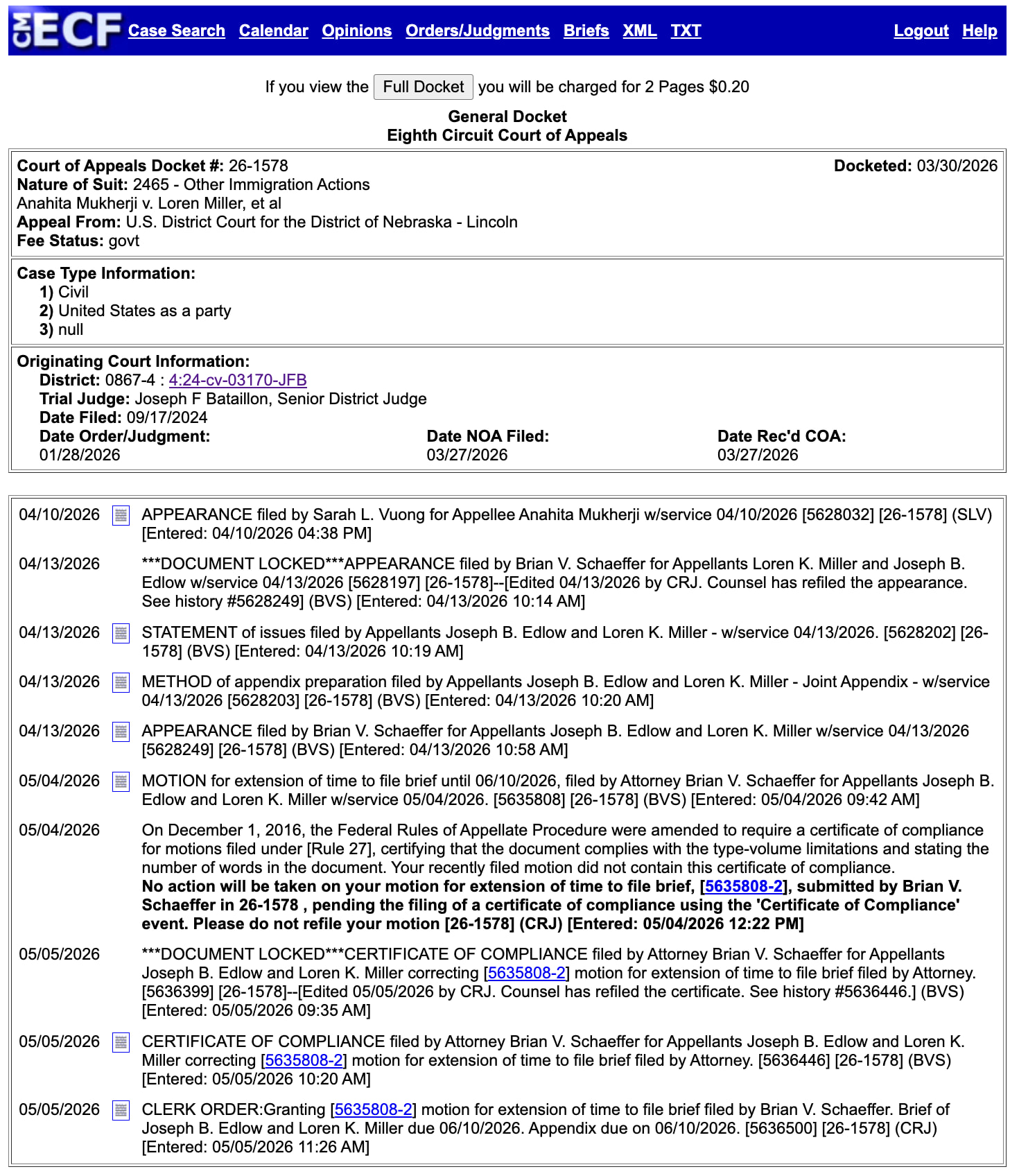
Full chronology. What actually happened in the case
From the Eighth Circuit docket for No. 26-1578 we can reconstruct this timeline. (A docket is the court’s case record — a log of all filings and events with dates.) I list day by day because the details are revealing.
March 30, 2026
Case docketed in the Eighth Circuit. Schedule set: government opening brief and appendix due May 11.
April 1, 2026 (12:39 PM)
Brian Scott Green, who won at the district court, files an appearance for Mukherji.
April 1, 2026 (7:26 PM)
Hours later, Jessica Ariela Dawgert enters the case. We’ll return to this name separately.
April 10, 2026 (4:38 PM)
Sarah L. Vuong joins as a third counsel for Mukherji. Also a separate storyline.
April 13, 2026
For the government, Brian V. Schaeffer (Trial Attorney, Office of Immigration Litigation, Civil Division, DOJ) files a Statement of Issues and Method of Appendix Preparation — the parties agree to a Joint Appendix.
May 4, 2026 (morning)
Schaeffer files an UNOPPOSED MOTION FOR EXTENSION OF TIME — asking for a 30‑day extension. Mukherji’s counsel does not oppose (standard courtesy under FRAP 26(b)).
May 4, 2026 (12:22 PM)
The court clerk returns the motion noting a missing Certificate of Compliance — the required certificate that the filing complies with page limits. The clerk wrote: “No action will be taken on your motion ... pending the filing of a certificate of compliance”.
May 5, 2026 (9:35 → 10:20 → 11:26 AM)
Schaeffer files the certificate three times before it is accepted. At 11:26 AM the clerk issues an order: extension granted. New deadline for the opening brief and appendix: June 10, 2026.
So by May 15 there is no opening brief in existence. The deadline was officially pushed by exactly 30 days. This information isn’t in public sources — not on Brian Green’s LinkedIn, not in immigration blogs. PacerMonitor didn’t update its card after May 8, so public indexes miss this.
Why the DOJ asked for an extension. Direct quote
The motion text is routine, no sensational reasons. No strategic shift, no political drama. Schaeffer literally wrote:
Brian V. Schaeffer, Unopposed Motion for Extension of Time, May 4, 2026
“Due to deadlines in other cases and preplanned leave during the month of April, an extension of time is necessary in order to the undersigned to fully develop the opening brief.”
Put in plain language: “The attorney had other cases and preplanned leave in April, so they couldn’t finish the brief.” This is the most standard wording for an extension motion in U.S. appellate practice.
Mukherji, through counsel, did not oppose. The motion explicitly states in its first paragraph: “Counsel for Plaintiff-Appellee indicated she has no objection to this motion for an extension of time.” A routine professional courtesy.
What’s up with Mukherji’s petition itself. The main gap in the public picture
Bataillon on January 28, 2026, issued a remand-with-instructions-to-approve. (A remand usually sends the case back to the agency for reconsideration; remand-with-instructions-to-approve is a rarer, stronger form where the court orders approval.) By rule, that decision isn’t automatically stayed by filing an appeal. To freeze enforcement, DOJ would need to file a motion for stay pending appeal.
In the Eighth Circuit docket I pulled from PACER, there is no motion for stay. The district court docket’s public preview also shows neither a stay motion nor a Notice of Compliance from USCIS that the petition was approved. (A Notice of Compliance would be the filing reporting that the agency complied with the court order; if USCIS had approved the petition, such a Notice should appear.) Formally, by the letter of the rules, USCIS was obligated to approve Mukherji’s petition.
Three scenarios are possible:
USCIS already approved the petition
If so, the appeal becomes largely moot as to the individual claim. DOJ might press the case for precedent (a recurring controversy). Mukherji personally would have received the outcome, and the district court’s findings would stand as persuasive even if reversed.
USCIS did not approve, and DOJ did not file a stay
That could be contempt of court. For agencies it usually results in monetary sanctions or judicial enforcement, not criminal charges. Green could move to enforce the order alongside the appeal — a much more aggressive scenario.
The parties agreed to an informal freeze
USCIS hasn’t approved but Green is not pushing in exchange for some unstated concessions in the appeal. Also possible, but such a deal would likely be visible publicly as well.
What I know and don’t know
As of May 15 I have no public confirmation that Mukherji’s petition was approved, nor any confirmation it was denied. You can close this gap by checking the district court docket for case 4:24-cv-03170. The mere absence of a stay motion from DOJ is already a signal. If they seriously feared that approval would create a factual fait accompli undermining the appeal, a stay motion would be the first step. They did not file one. So either they believe the appeal can win even after approval, or there was no approval and they and Green quietly agreed on it.
Who is actually on the other side of the barricades
This is the most interesting part, and why PACER digging was worth it. Four names are in the filings, and each tells its own story.
Brett A. Shumate. Assistant Attorney General
Shumate is the 36th Assistant Attorney General for the Civil Division of the U.S. Department of Justice. The Civil Division is one of DOJ’s largest components; OIL sits within it and handles immigration litigation for USCIS. Assistant Attorney General (AAG) is a high-level, Senate-confirmed political appointee. Shumate is a Trump appointee in his second term.
- Confirmed by the Senate on June 9, 2025 by a 51‑41 party-line vote.
- Education: Furman University (BA), Wake Forest University School of Law. Clerked for Judge Edith H. Jones (5th Cir.), a staunchly conservative jurist.
- Career: partner at Wiley Rein (from 2015), DOJ during Trump 1.0 (2017–2019), then Jones Day — a known pipeline for conservative lawyers into Trump administrations.
- Member of the Federalist Society Executive Committee 2016–2025 (nine years).
- In the first Trump term he defended issues like citizenship questions on the census, rollbacks of DACA, and Emoluments Clause litigation.
Crucially for our case: on June 11, 2025 — the day after his oath — Shumate issued a Civil Division enforcement priorities memorandum (see the memo, analysis at WilmerHale, news coverage at NPR). Priority No. 5 reads in part:
Brett A. Shumate, Civil Division Enforcement Priorities Memorandum, June 11, 2025
“The Civil Division shall prioritize and maximally pursue denaturalization proceedings in all cases permitted by law and supported by the evidence.”
So denaturalization was elevated as a priority. That public memo, issued immediately upon taking office, sets the Civil Division’s tone.
What this means for Mukherji v. Miller
Shumate’s signature on the motion is not a routine sign-off. It signals that this appeal is under the ideological umbrella of an AAG whose mandate is to expand the government’s ability to strip immigrants of status. Shumate isn’t an EB-1A specialist, but the broader institutional frame is clear: Civil Division under him will fight to preserve or expand government control over immigration adjudications.
Glenn M. Girdharry. Acting Deputy Director, OIL
Glenn Matthew Girdharry (New York State Bar #4375861, Tulane Law graduate, admitted 2006) has been at DOJ’s Civil Division / Office of Immigration Litigation since summer 2010 — roughly 16 years in the same office.
A small detail in the filing explains much. On the Statement of Issues’ cover he’s listed as Deputy Director; in the signature block a page later he signs as Acting Deputy Director. Looks like part of the document used an older template and another part was updated — a very recent acting appointment.
Why now? OIL experienced a staffing shake-up in 2025:
- February 2025: David McConnell left (former director of OIL Appellate), refusing to move to a new Sanctuary Cities Enforcement Working Group.
- April 2025: Erez Reuveni (then-Acting Deputy Director OIL DCS) was removed, and his supervisor August Flentje (Deputy Director OIL) was placed on administrative leave. Context: the Abrego Garcia case over erroneous deportation.
So OIL’s senior tier was reshuffled in 2025. Girdharry, an experienced Assistant Director DCS with 16 years at the office, is a natural acting replacement.
He’s not a bureaucrat only; he litigates. In April 2025 he argued in district court in Liu v. Noem (D.N.H.), a widely reported SEVIS termination case that a judge described as “a bit Kafkaesque.”
He also oversees parallel cases with national implications:
- Gomez v. Trump (D.D.C. 2020) — challenge to Presidential Proclamation 10014.
- Liu v. Noem (D.N.H. 2025) — SEVIS termination.
- United States v. City of Rochester (W.D.N.Y. 2025) — suit against a sanctuary city.
- Chamber of Commerce v. DHS, No. 25‑5473 (D.C. Cir. 2025–2026) — challenge to a proclamation imposing a $100,000 fee for new H‑1B filings.
Notably, Chamber of Commerce v. DHS and Mukherji are under the same broader policy canopy: defending USCIS’s adjudicative authority in the post-Loper Bright era. DOJ is coordinating defense of agency deference across multiple fronts, and Girdharry supervises both positions.
What this indicates
DOJ treats Mukherji not as a narrow APA review of one journalist’s denial but as a programmatic appeal with nationwide implications. They will defend the Kazarian Step 2 framework itself, not merely argue narrow factual grounds.
Brian V. Schaeffer. Trial Attorney
This is the most striking find. On paper Schaeffer looks like a rank-and-file DOJ trial attorney. But his background reveals a surprising trajectory.
- Texas Bar #24063128, admitted May 2008 — about 18 years of experience by 2026.
- J.D. University of Houston Law Center (Dec 2007); BA Mississippi College (2000).
Archived legal directories (Avvo, Lawyer.com) show his prior profiles. Before joining DOJ, Schaeffer was on the other side of the docket:
- He ran Schaeffer Law Firm in Houston, filing petitions on behalf of immigrants.
- His firm specialized in EB‑1, EB‑2, NIW, outstanding researcher, extraordinary ability — exactly the practice area EB-1A falls into.
- Lawyer.com associated him with RAICES (a Texas immigrant legal nonprofit).
- His past profiles list many languages.
In plain terms
Brian Schaeffer once submitted EB‑1A petitions on behalf of immigrants and faced Final Merits Determination as a denial tool. Now he is on the other side, writing a brief defending the very procedure he used to contest. That career trajectory matters.
At the district court level (D. Neb., 4:24‑cv‑03170), Schaeffer was the lead or sole DOJ counsel and lost — badly — with one of the most sweeping APA verdicts possible. Now he is drafting the opening brief on appeal. That’s atypical: after such a defeat, appellate specialists usually take over. Here, the team kept the attorney who lost.
Mukherji’s team. The biggest discovery in this story
I must be candid. In earlier drafts I described Green as a solo practitioner carrying the case alone against the state machine. That turned out to be wrong. A deeper PACER and LinkedIn dive changed the picture.
Mukherji’s appellate team officially lists three attorneys, all in Denver:
- Brian Scott Green — Law Office of Brian Green, Denver. Lead counsel who won below.
- Sarah L. Vuong — Ariela Lake Law & Consulting PLLC, Denver.
- Jessica Ariela Dawgert — Ariela Lake Law & Consulting PLLC, Denver.
All three appear on the docket as [NTC Retained] — retained and paid by the client, not pro bono. Who is funding three attorneys against the U.S. government is an open question: Mukherji herself, her employer, crowdfunding, or Ariela Lake taking a reduced-fee case for marketing. That’s speculative.
Sarah Lake Vuong
California Bar #258528 and LinkedIn show Vuong is a UVA (BA) and University of Pittsburgh (J.D. + Masters in Public and International Affairs, 2008) graduate. Admitted in California and in the U.S. Supreme Court.
Career per LinkedIn:
- Began as an Attorney Advisor in a San Francisco immigration court.
- Sept 2018–Apr 2020: Associate Counsel, USCIS Office of Chief Counsel, Litigation and National Security Coordination Division — i.e., she worked inside USCIS.
- Oct 2010–Dec 2023: Trial Attorney, DOJ Civil Division, Office of Immigration Litigation.
- Nov 2020–Dec 2023: Senior Litigation Counsel, OIL.
- Dec 2023–Aug 2025: Assistant Director, OIL. One of the 4–6 top positions in the office.
- Sep 2025–Dec 2025: Senior Attorney at Blessinger Legal PLLC.
- Jan 2026–present: Partner at Ariela Lake Law & Consulting PLLC.
Her firm bio emphasizes Vuong’s specialties: Temporary Protected Status, naturalization eligibility, and denaturalization. Her early trial work includes Pirir‑Boc v. Holder (9th Cir. 2014). Her last high-profile matter as Assistant Director OIL was National TPS Alliance v. Noem (9th Cir. No. 25‑2120, Aug 29, 2025), on the government side.
Vuong specializes in denaturalization — precisely Priority No. 5 in Shumate’s memo. She left DOJ in August 2025, two months after Shumate’s memo. That timing is notable.
Jessica Ariela Dawgert
Dawgert’s resume is even more powerful than Vuong’s:
- 20+ years in immigration law and policy.
- 15+ years at DOJ.
- Held positions including Associate Deputy Attorney General and Senior Litigation Counsel.
- In those roles she oversaw immigration policy, drafted regulations, and litigated and supervised thousands of cases across 12 circuits.
- Previously a Staff Attorney at the U.S. Court of Appeals for the Second Circuit.
- Brooklyn Law School (J.D.), University of Miami (B.S.). Admitted in New York, D.C., and the U.S. Supreme Court.
An Associate Deputy Attorney General is not “above” an Assistant Director OIL in a direct chain — rather it’s a lateral/higher coordinating position working for the Deputy AG and coordinating across DOJ’s components.
Her firm bio literally says she oversaw immigration policy, drafted regulations, and supervised thousands of cases — institutional knowledge at the highest level. Whether she directly worked on EB‑1A or the Kazarian framework publicly is unknown. But her institutional memory of DOJ’s processes is top-tier.
One more nuance: on the Eighth Circuit docket Dawgert still signs using her former DOJ title: ‘Jessica Ariela Dawgert, Senior Litigation Counsel’. That’s unusual after leaving the agency and signals to the court: remember who I was.
Firm history. Ariela Lake Law
The firm’s name says a lot. Ariela is Dawgert’s middle name; Lake is Vuong’s middle name. It’s their joint firm.
Vuong announced the new firm on LinkedIn in January 2026:
Sarah Vuong, LinkedIn, Jan 2026
“New year, new beginnings! I am so excited to partner with my wonderful friend and colleague Jess Dawgert in opening Ariela Lake Law & Consulting PLLC!”
Timeline: firm opened in January 2026. On January 28, 2026, Bataillon issued his district court decision. On April 1 Dawgert entered the appeal; on April 10 Vuong entered. They were not present in district court when Green won — the firm formed just after the district win and two ex-DOJ insiders joined on appeal. Mukherji was among the firm’s earliest high-profile clients.
In its first four months the firm has already won at least two notable matters: Ortez‑Reyes v. USCIS (4th Cir., Mar 2026) and a habeas matter in April–May 2026 where Vuong did the heavy lifting (per Dawgert).
Unprecedented asymmetry by status
Compare the teams.
On Mukherji’s side:
- Brian Green — Denver solo who won below.
- Sarah Lake Vuong — former Assistant Director OIL, former Associate Counsel USCIS, former Attorney Advisor in immigration court. 13+ years in DOJ. Supreme Court admission.
- Jessica Ariela Dawgert — former Associate Deputy Attorney General, former Senior Litigation Counsel DOJ, ex‑Second Circuit staff attorney. 15+ years in DOJ. Supreme Court admission.
On the government’s side:
- Brett Shumate — political appointee, not an EB‑1A specialist.
- Glenn Girdharry — Acting Deputy Director OIL.
- Samuel Go — Assistant Director OIL, former direct colleague of Vuong.
- Brian Schaeffer — Trial Attorney who lost below and previously filed EB‑1A petitions on behalf of immigrants.
Incredible status asymmetry
Mukherji has two former top-tier DOJ attorneys, both with Supreme Court admission. Dawgert once held a position functionally higher or lateral to today’s Girdharry. They drafted regulations and shaped policy within the same system Mukherji now challenges. Vuong and Samuel Go literally held Assistant Director titles in the same office as peers. This is not merely appellate co-counsel assisting a solo — it’s a team of insiders who know OIL inside out now representing an immigrant client.
Why they left DOJ is not publicly stated. Many reasons are possible. The timing, however, is suggestive: Shumate’s denaturalization memo came June 11, 2025; Vuong left DOJ in August 2025 and now lists denaturalization among her specialties. Strong circumstantial evidence, but not proof of motive.
A community of ex‑DOJ lawyers has formed around boutique firms like Blessinger Legal; Ariela Lake is part of that ecosystem and is already connecting to large Denver firms. At an April 28 CLE on habeas, Dawgert spoke alongside Laura Sturges of Gibson Dunn.
Statement of Issues. The first window into DOJ’s strategy
This is the most valuable document in the case. I paid for and downloaded the Appellant’s Statement of the Issues filed by Schaeffer on April 13, 2026 (docket entry ID 5628202). It’s a short four‑page filing in which the appellant must list the specific questions it intends to present to the court. Think of it as the table of contents for the forthcoming brief: not the arguments themselves but the dispute axes.
Under FRAP 28(a)(5) and local 8th Cir. R. 28A(i), the appellant identifies its issues, and those axes define the perimeter of the appellate review. The DOJ stuck to a disciplined short list — only three issues on four pages. OIL didn’t dump everything into the record; they picked three precise battles.
Literally the three issues DOJ intends to present
Issue 1. Did the district court err in holding that USCIS’s long-standing two-step approach to EB‑1A classification — the approach described in Kazarian v. USCIS (9th Cir. 2010) and Amin v. Mayorkas (5th Cir. 2022) — was arbitrary, capricious, an abuse of discretion, or otherwise not in accordance with law?
Issue 2. Did the district court err in holding that the two-step approach required notice-and-comment rulemaking under 5 U.S.C. § 553?
Issue 3. Did the district court err by addressing the merits of the Plaintiff’s claims and remanding with instructions to approve the petition?
What DOJ is building its attack on
Issue 1 is DOJ’s core defense: they will argue federal appellate precedent supports the two-step approach. There is nuance: Kazarian is a 9th Circuit decision that described the two-step approach — but Kazarian’s appellant lost in that case. Importantly, Kazarian did not perform a standalone APA analysis of the procedure; it effectively described the practice with implicit approval. So Kazarian is more of a source citation than an active doctrinal shield.
A weakness in DOJ’s approach: Amin (5th Cir. 2022) was decided before Loper Bright. Amin relied partly on older Chevron-style deference, which Loper Bright limited. And in the Statement of Issues DOJ makes no mention of Loper Bright — they act as if that Supreme Court decision didn’t exist.
Issue 2 is the procedural attack: characterize Final Merits as an interpretive rule rather than a legislative rule, and thus exempt from notice-and-comment. In short: if it’s an interpretive rule, no APA rulemaking required; if it adds a new obligation, it’s legislative and required notice-and-comment. Bataillon held Final Merits was a legislative-type rule requiring notice-and-comment.
Issue 3 attacks the remedy. DOJ invokes Supreme Court doctrines (Florida Power & Light v. Lorion and INS v. Ventura) that generally instruct courts to remand to the agency rather than substitute their own decision. The government’s argument: district courts shouldn’t order agency approvals; they should remand for reconsideration.
This is DOJ’s clever strategic backstop. Issue 3 provides a parachute even if DOJ loses on the legal doctrines: they can argue the proper remedy is remand rather than an order to approve, which could result in Mukherji losing a practical victory even if she wins on legal grounds. The worst outcome for Mukherji personally: win the legal issues but not get the green card because the matter goes back to USCIS.
Asymmetric burden math
Bataillon ruled on five independent grounds; any one would suffice. DOJ compressed those five into two analytical tracks:
- Issue 1 — the substantive track: covering Bataillon’s findings related to Encino Motorcars (the Supreme Court decision requiring agencies to publicly acknowledge policy shifts and explain them), Loper Bright, and the absence of a recency requirement.
- Issue 2 — the procedural track: addressing the legislative vs. interpretive rule question and the lack of notice-and-comment.
Under Bataillon, one of these defects would be enough to vacate the denial.
There’s another supporting pillar DOJ largely ignores — Encino Motorcars, the Supreme Court decision about acknowledging a policy change. Encino is an independent route to affirmance that DOJ does not press in the Statement.
So Mukherji could prevail even in a weaker scenario: by winning either Issue 1 or Issue 2, and Encino serves as an additional independent support. DOJ’s task is to win two axes simultaneously while avoiding the court relying on Encino — a tall order.
What’s missing from the Statement, and why that speaks volumes
Silence sometimes speaks louder than words. Notably absent are:
- Any mention of Loper Bright. This is the largest strategic omission. DOJ will likely pivot in the opening brief to Skidmore or Auer-type arguments — doctrines that survived Loper Bright — but Loper Bright itself is omitted.
- No separate framing of the so-called recency requirement. Bataillon expressly held there’s no statutory “must be constantly on top” requirement; DOJ lumps that point into Issue 1 instead of treating it separately.
- No framing that Mukherji is a unique, idiosyncratic case. DOJ treats it as a nationwide defense of procedure.
- No explicit naming of Final Merits Determination; they use safe language like ‘two-step approach’ in quotes — careful linguistic hygiene.
- No attempt to contest Bataillon’s fact-finding that Mukherji satisfied many of the EB‑1A criteria. The dispute is framed as legal — legitimacy of the procedure and the remedy — not factual.
The most important practical takeaway right now
Judge Bataillon’s wording about not requiring perpetual prominence — the quote that works in RFE responses the same way now as in January — is not challenged by the appeal. That line remains live. For practitioners drafting RFE responses right now, that judicial quote remains a principal weapon and is not under threat from the appeal.
What Green will answer. Architecture of the response brief
Knowing DOJ’s three issues, we can predict Mukherji’s response structure fairly precisely.
- Against Issue 1 — center Loper Bright. Green must place Loper Bright at the core, portray Amin as a pre‑Loper Bright artifact, and highlight that Kazarian did not adjudicate APA questions.
- Against Issue 2 — use D.C. Circuit precedents like Mendoza v. Perez and American Mining Congress v. MSHA to distinguish interpretive versus legislative rules. The argument: a rule that adds an obligation not in the regulation is by definition a legislative rule.
- Against Issue 3 — two main counters. First, the futility doctrine: when remand would be pointless because the agency’s reexamination can only lead to the same outcome, courts may appropriately grant relief. Second, the standard of review for remedy is abuse of discretion; DOJ must show not merely an error, but that Bataillon’s remedy was outside the range of reasonable options. That’s a high bar.
What this all means for appeal odds
In Mukherji’s favor: DOJ offered a narrow Statement of Issues. They omitted Loper Bright, the 2010 policy shift (Encino angle), and the perpetual-recognition requirement. Loper Bright remains a central tool for Green. Mukherji’s team is strengthened by insiders — former top DOJ attorneys who know OIL and personally know Schaeffer and Girdharry. The staffing changes at OIL (departures of McConnell, Reuveni, Flentje, and Vuong) objectively weaken the government.
In the government’s favor: Shumate’s ideological frame and prior circuit precedent (Amin) help. Their attack is focused — narrow issues are easier to win. Issue 3 serves as insurance. Schaeffer knows this case intimately.
A political tilt adjustment: the Eighth Circuit is among the more conservative circuits. The panel will likely include multiple Republican appointees. That does not negate the legal math but is a realistic factor: on a conservative panel, even strong doctrinal positions can lose on narrow procedural grounds.
Standard of review matters. Issues 1 and 2 are pure legal questions reviewed de novo — the court reexamines the law from scratch. That’s neutral. Issue 3 (remedy) is reviewed for abuse of discretion — a tougher standard for the party challenging the remedy (DOJ). That raises the bar for DOJ on Issue 3, and Bataillon relied on futility to justify his remedy.
My view: Mukherji’s position in the Eighth Circuit is stronger. Bataillon’s decision rests on five independent grounds. DOJ attacks only two of them, and is silent on Loper Bright and Encino. To reverse, the Eighth Circuit must win on both Issue 1 and Issue 2 and overcome the other four independent grounds — a steep task.
An unpleasant warning about the other side of the coin
Mukherji’s district court victory currently exists only at the district level. Until the appeal is resolved, the Eighth Circuit has two paths to finish this:
The Eighth Circuit affirms Bataillon
That creates a circuit split with the Fifth Circuit (Amin). Circuit splits are the signal that the Supreme Court should resolve the issue. Mukherji would then become a national precedent, potentially reaching the Supreme Court.
The Eighth Circuit reverses Bataillon
That’s bad not only for Mukherji but for the entire EB‑1A practice. A reversal would cement Kazarian Step 2 at the appellate level once again. If the Eighth flips Bataillon, Judge Bataillon’s line about sustained recognition in RFE responses would be significantly weakened, and USCIS could more confidently rely on appellate precedent.
So the temporarily favorable window for district-court APA challenges — which Brian Green opened in January 2026 — could close by early 2027.
Practical consequence
If you currently have a fresh EB‑1A denial based on Kazarian Step 2 and you’re considering federal litigation, the favorable district-court precedent window may shut by 2027. Discuss options with counsel now rather than waiting. The more parallel suits filed across circuits by the time the Eighth rules, the easier it is to create a circuit split.
Silence in the bar community. Now it makes sense
In January–February 2026 there was a flurry of commentary (Murthy, Cyrus Mehta, JDSupra, Wildes & Weinberg, Mandamus Lawyers, Garfinkel). Then silence.
The last public trace from Brian Green was an Instagram post on March 28–29, 2026: “Kazarian is illegal. It’s been illegal since December 2010.” A few lawyers like Amber Davis kept the topic alive into late April.
Why the quiet? Simple: the brief was not filed. There was nothing to analyze. Now we know the government moved its filing to June 10, so no public fireworks until then.
Amicus briefs. Nobody filed, and that’s normal
Amicus briefs typically follow the appellant’s opening brief. I expected briefs from AILA, Cato, and Niskanen. As of May 15 none have filed.
Reason: without an opening brief there’s nothing for amici to respond to. With DOJ’s extension to June 10, amici will likely file in late June or early July after the government’s brief appears.
Oral argument. Not scheduled and shouldn’t be yet
The Eighth Circuit’s May 11–15 sittings cover Omaha and St. Paul but are unrelated matters. Mukherji isn’t on the oral-argument calendar and shouldn’t be yet. The appeal is still in the briefing phase.
With the extension to June 10, plus roughly 30 days for Mukherji’s response and a possible government reply, realistic oral-argument windows fall into October–December 2026.
What USCIS is doing in the meantime
Practically nothing public.
- Policy Manual. The internal USCIS Policy Manual section on EB‑1A (link) was last modified December 18, 2025, and still describes Kazarian two-step and Final Merits. USCIS did not react publicly to the January decision; it had already codified the contested practice one and a half months before the district ruling and has not removed those passages since.
- The regulatory docket (RIN 1615‑AC85, “Petition for Immigrant Worker Reforms”) has not published a NPRM in the Federal Register. RegInfo shows a planned NPRM dated 01/00/2026 but no publication yet.
- The AAO (Administrative Appeals Office) is not cited in Mukherji’s public filings. USCIS appears to be proceeding as if nothing happened.
- Service centers continue to issue Final Merits denials.
The picture hasn’t changed since my May 7 note: the house is burning, but the occupants are sipping tea.
Brian Green is no longer solo
I previously described Green as a solo practitioner. PACER’s case query clarified that he is not alone: Mukherji’s team includes Green plus co‑counsel from Ariela Lake Law, a boutique recently opened by former senior DOJ attorneys.
Green remains the lead counsel at his firm, but he engaged co‑counsel with deep insider credentials. After the January win Green published no further high-profile cases in the following months; the firm’s Litigation page wasn’t updated. Now, knowing about the extension, that silence is explained: the team awaited DOJ’s opening brief to reply to. Until June 10 there’s nothing to rebut.
What changes in my advice after May 7
Nothing fundamental. The district court decision remains in effect and Judge Bataillon’s quote about sustained recognition continues to function as a key argument in RFE responses.
One change: I previously told readers to watch May 11. Now the date to watch is June 10. The government’s opening brief should appear then and reveal DOJ’s full appellate theory under Shumate, Schaeffer, and Girdharry.
Where I’ll be watching in the next three to four weeks
- PACER docket for 26‑1578. The opening brief will be visible there once Schaeffer files it; expect the filing around June 10–11.
- CourtListener RECAP for free copies — RECAP often publishes briefs a few days after PACER.
- Brian Green’s LinkedIn. He quickly publicized the January win; once the government brief posts he’ll likely comment.
- Blogs: Cyrus Mehta, Murthy, Reddy Neumann Brown, Robinson Immigration/JDSupra — they typically analyze briefs within days of RECAP posting.
- Amicus briefs from AILA, Cato, Niskanen Center — expect filings late June–early July after the government brief.
- Federal Register for RIN 1615‑AC85. If USCIS tries to bypass appellate proceedings via formal rulemaking, the NPRM would be the first sign.
I’ll post another update as soon as anything new appears.
Short summary of the update
Main as of May 15
The opening brief due May 11 was not filed. DOJ requested an extension; the new deadline is June 10, 2026. The reason given was routine — attorney workload and planned leave in April.
Biggest revelation: Mukherji’s team is not Green solo; it’s a trio from Denver. Two are former top-tier DOJ lawyers: Sarah Lake Vuong (former Assistant Director, OIL, left DOJ Aug 2025) and Jessica Ariela Dawgert (former Associate Deputy Attorney General). Both have Supreme Court admission. In January 2026 they launched Ariela Lake Law & Consulting in Denver (the firm name combines their middle names). Mukherji is among the firm’s first major appellate clients.
Government team: Brett Shumate (political appointee AAG), Glenn Girdharry (Acting Deputy Director, OIL), Samuel Go (Assistant Director, former Vuong colleague), and Brian Schaeffer (Trial Attorney who lost below and formerly filed EB‑1A petitions).
Unprecedented status asymmetry: Dawgert held a DOJ position functionally higher than today’s Girdharry.
DOJ’s narrow attack: three issues out of five possible Bataillon grounds. Loper Bright, Encino Motorcars, and the sustained-recognition requirement are not directly challenged in the Statement.
Main math: Mukherji wins by prevailing on either Issue 1 or Issue 2; Encino is an independent supporting basis. Issue 3 (remedy) is reviewed for abuse of discretion, a higher bar for DOJ.
Panel composition caveat: the Eighth Circuit is relatively conservative; a right-leaning panel makes reversal more plausible on narrow procedural grounds.
Key threat to EB‑1A practice: if the Eighth reverses, Kazarian Step 2 would be reaffirmed at the appellate level again and the current district-court window could close by 2027. If you have a recent Kazarian Step 2 denial, consider discussing litigation options with counsel now.
Next checkpoint — June 10, 2026.
Disclaimer
Informational nature of the materials
This analysis is an independent review of public sources: the USCIS Policy Manual, the Federal Register, federal court materials (PACER), and official government publications. Links to primary sources appear in the article. The authors are not licensed U.S. attorneys and do not provide legal services.
This is not legal advice and does not substitute for it. For specific cases consult a licensed immigration attorney or an accredited DOJ representative. Use of this site does not create an attorney-client relationship.
U.S. immigration policy changes frequently. The article’s last-update date is in the header. If you spot outdated information, notify us and we will correct it.
Sources for this case: the appellate docket card on PacerMonitor for 26‑1578 (link) and the district court docket 4:24‑cv‑03170 (link).