I have always been inspired by real success stories. When I first started my path with the talent visa, I read the stories of ordinary people about their approvals. That was the magical push that set me on this slippery immigration road. Now it’s my turn to tell my story.
My name is Anzhelika, I’m Head of SMM and a digital marketer. I’ve been working in marketing for over 12 years. My passion is travel and work in travel&tech. My strength is viral organic content. I’m that person who started making funny meme reels before it became super popular and then everyone started doing it  I’ve collaborated with Aviasales, Travelpayouts, National Geographic, Booking, Get Your Guide, Expedia, Viator and others.
I started my path in 2024 when I moved to the U.S. on U4U and switched to TPS. It was obvious to me that this was a temporary status and I needed to take care of further legalization myself.
Back then it seemed to me that the talent visa was something astronomically unattainable. Me and talent? I always considered myself an ordinary specialist with a persistent impostor syndrome. I kind of know what I do, I have many years of marketing experience… but then what?

I found a million chats, forums and YouTube videos. I dug through a huge amount of information. My head was spinning. I didn’t understand what to latch onto — O-1, EB-2 NIW or EB-1A?
I wanted it fast and reliable, to get a green card basically “tomorrow”
O-1 was out because after it you still need to “upgrade” the visa to get a green card.
EB-2 NIW appealed to me a lot, and I considered it seriously: I had a master’s degree in marketing, many certifications, many years of experience and some publications. But that visa isn’t fast either: just waiting for the visa bulletin after approval takes more than a year, and then another 1–2 years for the green card itself.
So I thought: why be modest? You should bet higher right away — and naively dove into that EB-1A cauldron.
I think my naivety, not understanding the scale of difficulty and some kind of maximalism played a role here. Like: “Well, many will fail, but I’ll do it in one go” 
I looked at lawyers and even saved a few contacts. Initially I wanted to collect the evidence myself and only then decide whether I needed a lawyer.
But after I gathered the criteria and dove deep into the process, I realized I could assemble the case myself. For extra confidence I still took separate consultations with lawyers and with Egor Akimov to finally “tidy up” the petition.
I started studying the criteria. Judging gigs, academic articles, associations… All of this seemed unreal and unattainable. I had never done anything like that and didn’t know where to start.
Where to get judging gigs? Where to publish academic work? Which associations fit? Which media are considered relevant?
At this stage I made a lot of financially unwise mistakes:
-
paid a lot of money to a PR person who didn’t really help much;
-
bought expensive useless articles;
-
joined irrelevant associations;
-
paid membership fees just “for the numbers”.
I tried to do everything at once and hoped this chaotically assembled pile of evidence would somehow pass.
Then I took several consultations — including with Egor Akimov. He explained to me concisely what was really strong and what was irrelevant and shouldn’t be added to the case. That helped a lot to structure my thoughts and understand what I could actually assemble.
In the end I built a strategy with these criteria:
-
Critical role — work in large travel&tech brands.
-
Media — publications about me, including a couple of articles in major media (40M+ visits per month) and industry marketing outlets.
-
Judging gigs.
-
Academic/expert articles.
-
Contribution to the industry — an SMM framework that helped brands grow social media.
-
High salary.
-
Associations (ECDMA and UMA).
It took me about 6–8 months to collect the criteria.
CRITICAL ROLE
I attached my work with Aviasales’ social media, as well as collaborations with other large travel&tech brands. From that came my SMM framework for the “Contribution to the industry” criterion.
JUDGING GIGS
I put together a pitch deck and started applying to all sorts of judging opportunities. I started with judging for ECDMA and Globee.
Then more serious organizations began to consider me and invite me.
I judged PHNX Awards from AdForum and a series of judging panels from the British Don’t Panic Events; Effie Awards US wrote to me and invited me to judge offline in Texas.
After that everything developed very organically, and literally in half a year to a year I accumulated more than 10 strong international judging roles.
They were judging gigs:
-
with strong jury members,
-
with well-known companies,
-
by invitation,
-
with major media,
-
and, importantly, specifically in marketing and SMM.
ACADEMIC AND EXPERT ARTICLES
To be honest, this turned out to be the easiest criterion for me, even though I initially treated it as a checkbox.
I didn’t aim for Scopus — after all, I’m not an academic researcher.
I made a list of relevant journals (Ukraine, CIS, Europe, USA) and sent publication requests myself.
The same was true for expert articles for major media and industry outlets, for example Cossa.ru.
I attached my pitch deck: who I am, what my expertise is and what I want to write about.
Most publications were free. Journalists readily agreed.
There were also “paid” articles, but later I regretted including them in the case. Spoiler: in the second filing I didn’t include them.
FIRST FILING
I had a crushing 30-page RFE, and then — a denial.
Accepted:
-
academic articles,
-
judging gigs.
Not accepted:
-
Critical Role,
-
Media,
-
Associations (ECDMA and UMA),
-
Salary,
-
Contribution to the industry.
I was very upset. It felt like everything was for nothing and it wasn’t worth pursuing anymore.
A huge amount of time, money and nerves had been invested.
But then I read comments in chats and realized that much also depended on the specific officer. The RFE was almost a photocopy — we compared it with other cases.
The officer most disliked my contribution to the industry and the media.
I studied the RFE and denial very carefully and looked at what exactly the officer found lacking. Some evidence was ignored, but I decided I had presented it poorly and unclearly. Conclusions were drawn. I completely repackaged the petition.
I decided to remove the “Contribution” and “Media” criteria as separate categories and fold them into Critical/Leading Role and Final Merit.
Officers often nitpick the “Contribution” criterion, especially in marketing — it’s literally a red rag to a bull. Media are also evaluated very subjectively.
In the second filing I strengthened and reworked absolutely everything.
MISTAKES IN THE FIRST FILING
1.
I tried to stuff the un-stuffable to make the case look “more solid”.
In Final Merit I added a bunch of articles from Medium and HackerNoon, wrote a detailed biography from 2012, student projects, about my university, a million diplomas and certificates, etc.
Objectively — there was too much unnecessary filler.
2.
I added too many projects to the Critical Role.
Instead of focusing on one strong project, I blurred the focus and superficially described four at once.
The Critical Role itself was also poorly formulated.
The officer didn’t understand why I claimed extraordinary ability when from the outside it looked like “just someone doing their job”.
What was missing:
-
global benchmarks,
-
org structure,
-
explanation of managerial role,
-
emphasis on executive-level responsibility.
Even the position name “SMM” looked insufficiently serious to the officer. Although I had leadership duties and managed a team, I decided to be modest.
Distinguished organizations were also weakly described.
3.
For salary I compared myself to average SMM specialists in the Ukrainian market.
The officer wanted to see comparisons specifically with top-level marketers and upper percentiles.
4.
Final Merit was vague and unstructured.
Just a huge stream of biography, filler and everything at once.
There were LOIs from the U.S., but without specifics about what exactly I was going to do in the U.S.
5.
About associations:
-
I didn’t attach bylaws,
-
for jury members I attached only LinkedIn.
The officer explicitly stated that LinkedIn (as well as Wikipedia) is not a reliable source.
I poorly explained that associations accept members only for outstanding achievements.
6.
For media I attached only SimilarWeb.
There were few comparisons with external sources.
7.
I hardly described exhibits. Everything was too brief and thesis-like.
8.
The whole petition was poorly structured.
One continuous stream of text.
There were no:
-
tables,
-
charts,
-
diagrams,
-
visuals,
-
clear navigation.
SECOND FILING
In the second petition I left only 5 criteria:
-
Judging gigs (15+)
-
Academic/expert articles (15+ publications, 2 international conferences)
-
Critical/Leading Role (focus only on the Head of SMM position at Aviasales)
-
High salary (comparison with C-level marketing, not regular SMM)
-
Associations (I left only ECDMA)
FINAL MERIT
In Final Merit I emphasized different things:
- My contribution to the industry: a viral SMM strategy that major travel brands successfully used. I showed:
-
examples of application,
-
statistics and global benchmarks,
-
recommendations from CEOs.
- Recommendation letters from US peers (15+):
-
C-level at HBO,
-
Expedia,
-
Walmart,
-
Manychat,
-
professors from American universities,
-
presidents of the American Marketing Association, etc.
The letters were organic. I met these people through conferences, communication and work.
-
Active work in the position of CMO at an American health&tech startup.
-
An offer from a large health&tech clinic where the founder explicitly wrote that we had already started collaborating and approval of the visa would allow continuing the work and contributing to the healthcare industry.
-
The prospects of travel&tech and health&tech for the U.S.
-
Longevity of evidence. I showed that I have been actively working and delivering results since at least 2021.
About starting my career in 2012 and having a master’s degree in marketing, I almost didn’t write anymore.
The officer doesn’t need a huge amount of information. They have 20–30 minutes for a quick review of the case. The less fluff — the easier it is for them to perceive everything.
WHAT I CHANGED IN THE SECOND FILING
I structured all criteria in tables so the officer could more easily see the key information.
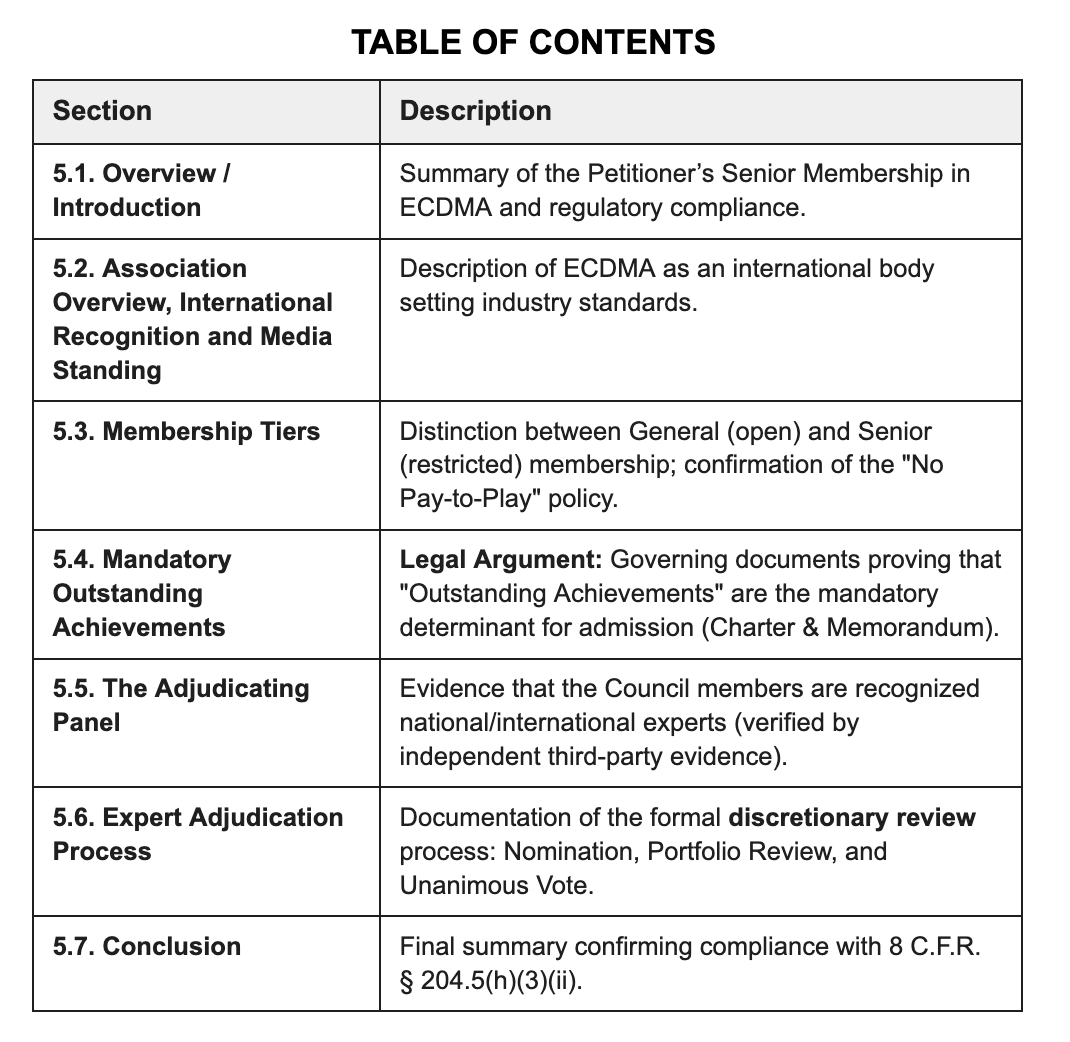
Example of how to present a judging association jury member in a memo
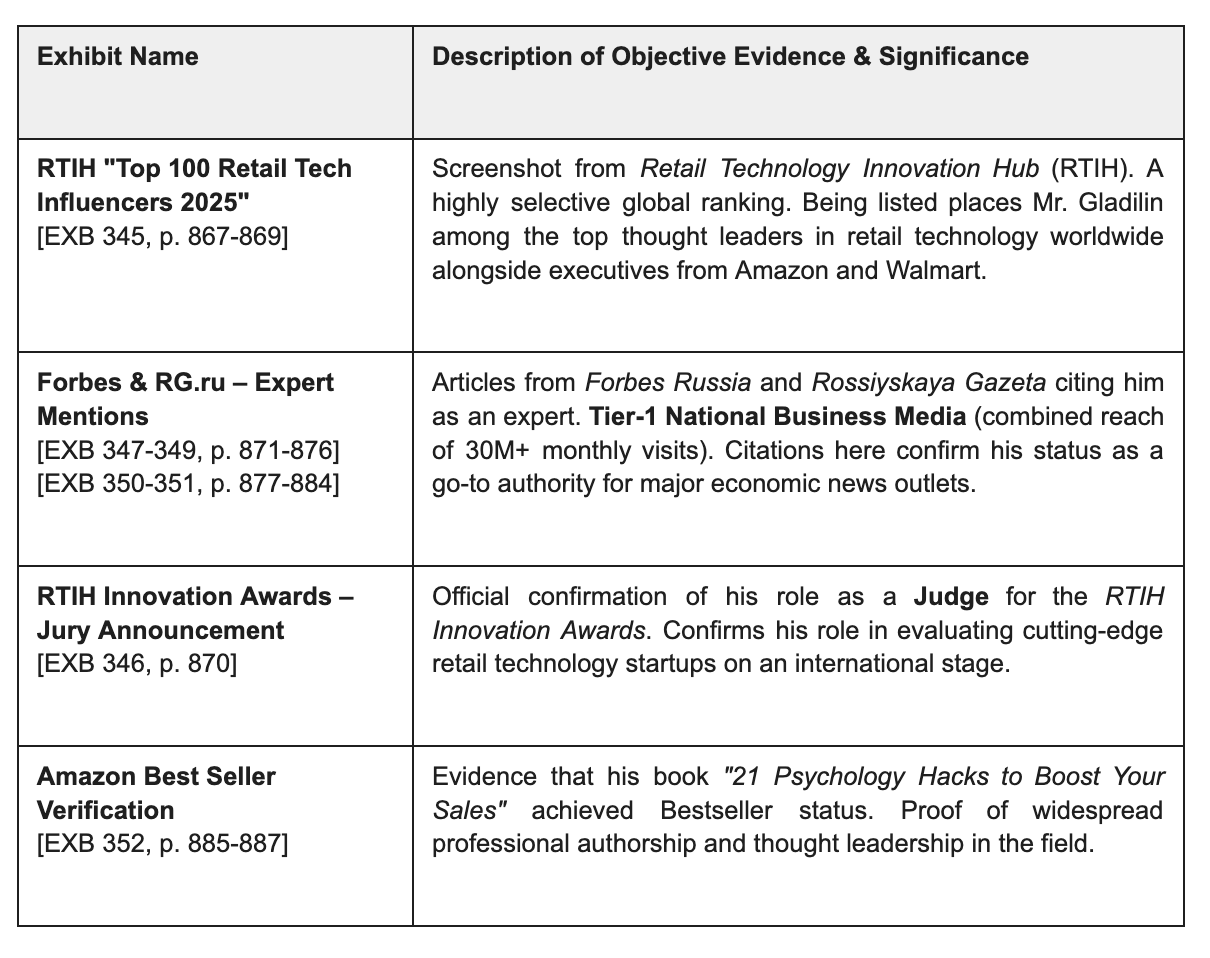
I removed:
-
the tear-jerking biography,
-
marketing buzzwords,
-
unnecessary diplomas,
-
everything that didn’t strengthen the case.
My task wasn’t to “sell myself”, but to show as dryly and logically as possible why my achievements go beyond the ordinary.
Not: “I’m a super-cool SMM who turned the industry upside down with memes.”
But: “Here’s the market benchmark. Here are my metrics — they’re 10x higher. Here’s the opinion of a Creative Director from Expedia. Here are articles in Forbes and independent sources in Bloomberg.”
I ran the petition through GPT, Claude, Gemini and Grok about 100 times with the prompt:
“You are a harsh USCIS officer in a bad mood who wants to give a denial. Critically evaluate the case and give feedback.”
After each such roast I rewrote the petition from scratch.
Then I gave the final version to a person who is not related to marketing at all. It turned out half of the text was incomprehensible to them They also gave feedback, and I added many explanations for people outside the industry.
**
RESULT**
1000+ pages.
Premium Processing. Texas Service Center.
Receipt Number date: April 17
Approval date: May 4
No RFE.
WHAT ADVICE CAN I GIVE
1.
Start with a strategy. One weak criterion can pull the whole case down. Weak purchased media can call even strong criteria into question. No strong media? Don’t paste anything random.
Better to file:
-
3–4 rock-solid criteria than
-
7 questionable ones.
2.
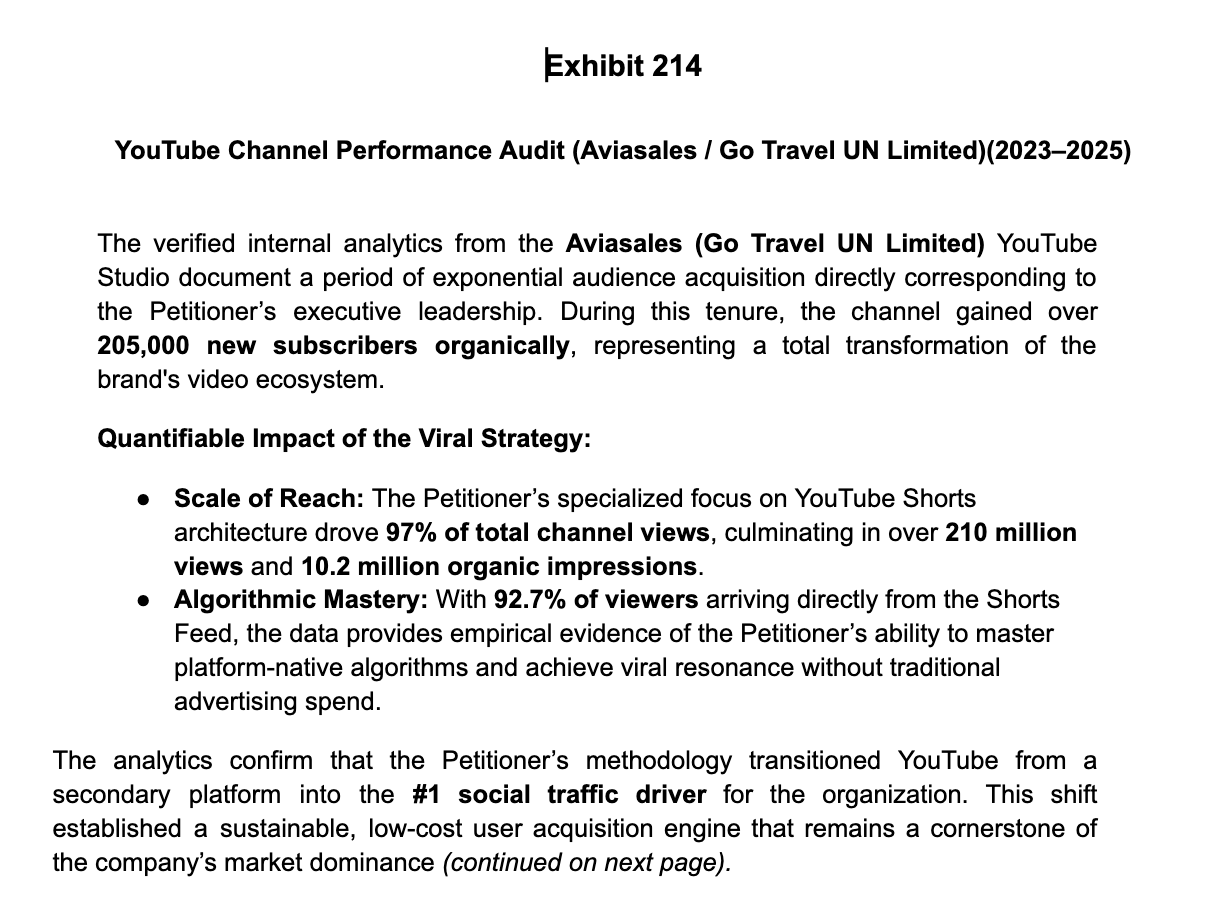
Remember the officer has little time. Your task is to make your case easy to navigate. My memo in the second filing was about 70 pages. But I, on the contrary, described exhibits very thoroughly.
Example of Exhibit formatting
3.
Getting the required 3 criteria is only half the battle.
Next is the Final Merit, which has been judged even more strictly lately.
You should have:
-
a clear plan of action in the U.S.;
-
an explanation of why you truly belong to the top percentile of your field;
-
strong recommendation letters;
-
a clear national interest;
-
offers or contracts;
-
sustained proven success for at least the past 5 years.
4.
Show that you can give the U.S. something ordinary specialists cannot.
I worked for almost a year in American health&tech because it’s an important and comprehensible niche for an officer.
DO YOU NEED A LAWYER/HELPER
It’s very individual. Preparing a petition on your own requires a huge amount of time and energy. You need to treat it like a full part-time job.
It’s important to understand that even when working with a lawyer, you’ll still have to collect the evidence yourself. The lawyer will work with what you provide, and if something is missing — they will tell you what else to strengthen or collect.
But don’t expect a lawyer to be as involved in your case as you are. Most of them have a large client flow, and many processes are put on a conveyor belt.
Lawyers greatly ease life in many ways. But you need to choose the specialist very carefully.
My acquaintances had different situations when working with lawyers:
-
someone’s full name of another person was accidentally inserted into the petition;
-
irrelevant criteria were added;
-
important awards or strong media were forgotten to be attached;
-
Final Merit was worked on superficially;
-
preparation of the case dragged on for months.
When you prepare the petition yourself, the probability of such mistakes is lower simply because no one will be more involved in your case than you.
THE RESULT
The whole process took me about 1.5–2 years.
Next I’m facing Adjustment of Status and other bureaucratic adventures. But these are already pleasant chores
By the way, now already in the status of a future stable resident I am open to collaboration and really want to find an interesting project in the U.S./global where I can realize my full potential as an SMM Lead/Head of Creative and other related positions.
Let’s be friends and collaborate!
LinkedIn: https://www.linkedin.com/in/angelaeva/
Telegram: @angelaeva