Practical filing guides
Filing fee - Document translation - Green Card photo - Document stamping/printing - Visa Bulletin - O-1 Petitioner
How to properly prepare document translations for USCIS: requirements, samples, and 5 mistakes that reduce evidentiary weight. Full analysis of 8 CFR 103.2(b)(3), translator certificate examples, and AAO practice.
What the law requires
If you submit to USCIS (U.S. Citizenship and Immigration Services) any document in a language other than English, it must be accompanied by a full English translation certified by the translator. Immigration officers do not read foreign languages — without a translation the document simply will not be considered.
The rule is established in 8 CFR 103.2(b)(3) — a section of the Code of Federal Regulations that governs filing documents with USCIS. If an officer finds a document without a translation or with a poor-quality translation, they may issue an RFE (Request for Evidence) or simply not credit the document.
Requirements for document translations
Literal text from the Code of Federal Regulations that defines translation rules.
"Any document containing foreign language submitted to USCIS shall be accompanied by a full English language translation which the translator has certified as complete and accurate, and by the translator's certification that he or she is competent to translate from the foreign language into English."
Translation: Any document in a foreign language submitted to USCIS must be accompanied by a full English translation which the translator has certified as complete and accurate, and by the translator's certification that he or she is competent to translate from the foreign language into English.
Who can translate
A translation may be done by a translation agency or a licensed translator, but this is not a mandatory requirement. In principle, any person fluent in both English and your native language can perform the translation.
The translation must be written in correct English without errors or ambiguities. It is recommended that the translation be done by a native (or near-native) English speaker. It does not matter if the text was initially produced by Google Translate or AI — but it MUST be edited by a person with excellent English.
The translation should not be signed by you or your family members. Although there is no direct prohibition, self-translation reduces the evidentiary weight of the document (more below).
Sample translator certificate
Each translated document must end with a signed translator certification. Here are two options:
Full wording
Full translator certificate (English)
I, [NAME OF TRANSLATOR], certify that I am fluent in the English and [ORIGINAL LANGUAGE] languages and competent in translating from that language to English. I further certify that I have translated the enclosed document entitled [TITLE OF THE DOCUMENT] from [ORIGINAL LANGUAGE] to English and that the translation is complete, true, and accurate to the best of my knowledge.
[SIGNATURE]
[DATE]
Translation of the certificate (for understanding)
I, [NAME OF TRANSLATOR], certify that I am fluent in English and [ORIGINAL LANGUAGE] and competent to translate from that language into English. I also certify that I have translated the attached document entitled [TITLE OF THE DOCUMENT] from [ORIGINAL LANGUAGE] into English and that the translation is complete, true, and accurate to the best of my knowledge.
Short wording
Short certificate (also acceptable)
I, [NAME], AM COMPETENT TO TRANSLATE FROM RUSSIAN INTO ENGLISH, AND CERTIFY THAT THE TRANSLATION OF THIS DOCUMENT IS TRUE, ACCURATE AND COMPLETE TO THE BEST OF MY ABILITIES.
[SIGNATURE]
[DATE]
Download sample certificates (PDF)
Download: 3 translator certificate samples for O-1 / EB-1A / EB-2 NIW
PDF with three ready examples (short, full, minimal format) + rules for formatting in Russian.
In-depth analysis
translator-certification-samples.pdf (110.8 KB)
Certificate for partial translation
If you translate not the whole document but only relevant parts — use one of these options:
Option 1: indicating omitted pages
I, [NAME OF TRANSLATOR], hereby attest that I am fluent in both English and [ORIGINAL LANGUAGE] languages, and that I diligently examined the document [NAME OF THE DOCUMENT] attached hereto in its entirety. Pages [X] to [Y] are omitted for efficiency as not pertinent to the subject matter of the enclosed petition. The remainder of the document is translated to the best of my knowledge and ability.
[SIGNATURE]
[DATE]
Option 2: translation of an extract
I, [NAME OF TRANSLATOR], hereby attest that I am fluent in both English and [ORIGINAL LANGUAGE] languages, and that the translation of the extract from [NAME OF THE DOCUMENT] attached hereto is translated to the best of my knowledge and ability.
[SIGNATURE]
[DATE]
When to use partial translation: If the document is long (for example, the company charter is 30 pages), but only specific sections are relevant to the petition — translate only those and indicate in the certificate exactly what was translated and why the rest was omitted.
10 rules for preparing translations
An English translation must be attached to each foreign-language document. Do NOT provide all translations in one folder or one document without corresponding originals. One certificate for all documents is not accepted (this has been explicitly stated in RFEs).
In-depth analysis
The translator’s certificate must specify WHICH document was translated. "I translated the enclosed document" without the title may be rejected.
The transliteration of the applicant’s name should match the spelling in the passport. If the passport says "Aleksandr" — the translation should also read "Aleksandr", not "Alexander". A mismatch may raise questions from the officer.
Do not transliterate abbreviations — expand them. OGRN is not "OGRN" but "Primary State Registration Number." INN is not "INN" but "Taxpayer Identification Number." OOO is not "OOO" but "Limited Liability Company." An officer may not know what "OGRN" means.
If the document has a seal or stamp with readable text — translate it. If the text is unreadable, it is acceptable to write "Seal/Stamp: Illegible." Describe state symbols (coats of arms) in words: "Coat of Arms of the Russian Federation." DO NOT insert images of coats of arms or logos — only textual descriptions.
A translation may be abridged and contain only the important parts of the original. This is acceptable and saves time and money. But the certificate must state which parts were translated (see partial translation certificate examples above).
Translations do not need stamps, seals, or notary oaths. A signed translator certificate indicating the title of the translated document is sufficient.
There is no need to use diacritical marks (é, è, á, ô, etc.) in the translation. Plain a, e, o, etc. without accents are sufficient.
All video or audio materials must have a transcript and an English translation.
The translator may insert a scan or image of their signature under the certificate. This is acceptable and convenient for electronic filings.
What a lawyer requires vs. what USCIS requires
If you work with an attorney, you will likely receive a two-page instruction on translations with a bunch of requirements. We analyzed public recommendations from 9 immigration law firms and compared them to what is actually written in 8 CFR 103.2(b)(3). Result:
[details=“Sources: 9 law firms and organizations we analyzed”]
1. Capitol Immigration Law Group (Washington, DC) — immigration law firm. Article “What are USCIS Requirements for Certified Foreign Language Translations?” Strictly by the law, do not add extra requirements. Cite 8 CFR 103.2(b)(3) without embellishment.
2. CitizenPath — online self-help immigration forms platform. Guide “Certified Translation for USCIS Applications”. They state plainly: “You or a family member may generally translate your own documents if you can certify that you are competent in both languages” — meaning self-translation is technically allowed. But they warn this is risky because the decision is at the officer’s discretion. They provide a certificate template on the page.
3. Khunkhun Law (New York, Madison Avenue) — immigration law firm. Article “What type of translations does USCIS accept?” They recommend typed translations: “USCIS officials find it easier to evaluate forms if the documents you provide are typed” — a practical tip, not a legal requirement.
4. Hope Immigration, PLLC (Cambridge/Boston, Massachusetts) — immigration law firm. Page “USCIS Certified Translations”. They warn: without a certified translation the petition may receive rejection or RFE. They cite 8 CFR 103.2(b)(3) and warn against Google Translate.
5. Law Offices of Michael D. Baker (Chicago, Illinois) — immigration attorney. Article “Certificate of Translation”. The only one of the nine who correctly separates USCIS and Immigration Court (EOIR) requirements. States explicitly: “Immigration Courts require as well that the certificate include the translator’s address and telephone number” — this is an EOIR requirement under 8 CFR 1003.33, not USCIS. An important distinction that other attorneys often confuse.
6. Warren Law Firm (San Francisco, California) — immigration attorney. Article “Translate Documents for USCIS Petitions”. They recommend finding translators experienced with immigration documents: “Just because someone is fluent in English doesn’t mean they will meet USCIS translating standards.”
7. ATA (American Translators Association) — the largest professional translators association in the U.S., members in 100+ countries. Their guide “Your Four-Step Guide to Meeting the USCIS Certified Translation Requirements” confirms: “USCIS does not require ATA certification, but by hiring an ATA-certified translator you will ensure you are working with a credentialed professional.” — ATA certification is useful but not mandatory.
In-depth analysis
8. Boundless — online immigration platform. Article “Translating Your Immigration Documents into English”. Important warning absent from others: “Some U.S. Embassies and consulates also restrict acceptable translators to certain agencies. The U.S. embassy in Athens, Greece, for instance, will only accept translations from the Greek Ministry of Foreign Affairs.” — for consular processing, check the specific consulate’s requirements.
9. Nanthaveth & Associates (Austin, Texas) — immigration law firm. Article “USCIS Document Translation”. They incorrectly claim: “USCIS does not accept self-translations, even if you are fluent in both languages. A third-party translator must complete and certify the translation.” — this is incorrect. 8 CFR 103.2(b)(3) contains no such prohibition. Self-translation is risky (see AAO practice) but NOT prohibited.
What the law actually requires (8 CFR 103.2(b)(3))
Only 3 items:
- Full English translation of the document (“full English language translation”)
- Translator’s certificate: translation is complete and accurate (“certified as complete and accurate”)
- Translator’s certificate: competent to translate from the given language (“competent to translate from the foreign language into English”)
That’s it. The law requires nothing more.
What attorneys add on their own
| Attorney requirement | In the law? | Actual status |
|---|---|---|
| Handwritten signature (not electronic) | Not in 8 CFR 103.2(b)(3) | But caution: in 2025 USCIS started issuing RFEs for suspicious signatures. A scanned handwritten signature is a safe option |
| “Under penalty of perjury” | No | The law only requires “certified as complete and accurate”. The phrase “under penalty of perjury” is not mandatory |
| Ban on Google Translate / AI | No | The law does not regulate the tool, only the quality of the result. But attorneys unanimously discourage Google Translate: Hope Immigration, CitizenPath, Warren Law Firm — all warn that Google Translate is unacceptable |
| Licensed translator / ATA | No | ATA (American Translators Association) is the largest translators association in the U.S. Even ATA confirms: USCIS does not require ATA membership or ATA certification |
| Notarization | No | All 9 attorneys confirm: not required |
| Translator’s address and phone | No for USCIS | Name and signature of the translator are required, but address and phone are not. However, for immigration court (EOIR) address and phone are mandatory under 8 CFR 1003.33. Attorneys often confuse the two requirements. Including contact info won’t hurt — it adds credibility |
| “Professional formatting style” | No | Not regulated anywhere |
| Translation must “mirror” the original format | No | Recommendation, not requirement |
About electronic signatures: be cautious
In 2025 USCIS began actively issuing RFEs for signatures that look "identical" across different documents — suspecting copy-paste.
Law firm Fragomen (one of the largest immigration firms worldwide, 6000+ employees, 60+ offices) on October 31, 2025 filed an official petition to DHS (Department of Homeland Security) asking to explicitly allow electronic and digital signatures on immigration forms. In that 15-page PDF Fragomen describes the problem: USCIS denies petitions due to "suspicious" signatures even when the signatures are genuine. The very fact of this petition indicates: today electronic signatures are NOT unambiguously allowed.
In practice: the translator signs a clean sheet once, photographs or scans the signature, and inserts this image into each PDF translation. This works. According to the USCIS Policy Manual (Volume 1, Part B, Chapter 2 - "Signatures"): "A signature is valid even if the original signature on the document is photocopied, scanned, faxed, or similarly reproduced." The main thing is that signatures should NOT look absolutely identical across different documents (this triggers suspicion of copy-paste).
One attorney explicitly states that self-translation is prohibited — this is false. 8 CFR 103.2(b)(3) does not contain such a prohibition. But self-translation lowers the probative value (evidentiary weight) of the document in the officer’s eyes — see section below. Of the 9 attorney sites analyzed: 3 say "technically possible but risky", 1 says "prohibited" (incorrect), the remaining 5 do not mention it.
Practical advice: Follow your attorney’s instructions if you work with one — they are responsible for the case. But if you file on your own, follow the law: full translation + certificate with signature (scanned handwritten) + translator’s competence statement. Address/phone of the translator are not required but can help.
Consular processing — separate rules
Important for those undergoing consular processing: The rules above apply to filing petitions with USCIS. But if after petition approval you undergo consular processing (an interview at an embassy), some consulates have their own translation requirements. For example, according to Boundless: "Some U.S. Embassies and consulates also restrict acceptable translators to certain agencies. The U.S. embassy in Athens, Greece, for instance, will only accept translations from the Greek Ministry of Foreign Affairs." Before your interview — check the specific consulate’s requirements.
Can you translate for yourself?
One of the most frequent questions. Short answer: you can translate, but it’s better not to sign the oath for yourself.
What the law says
8 CFR 103.2(b)(3) does not prohibit self-translation. The law only requires: (1) a full translation, (2) a certificate of accuracy, (3) a statement of translator competence. Who performs the translation is not regulated.
What practice shows
From an analysis of 800+ cases: objections to self-translation in RFEs are extremely rare (2–3 cases, all involving English teachers where the officer reasonably asked, “if you teach English, why couldn’t you find a translator?”).
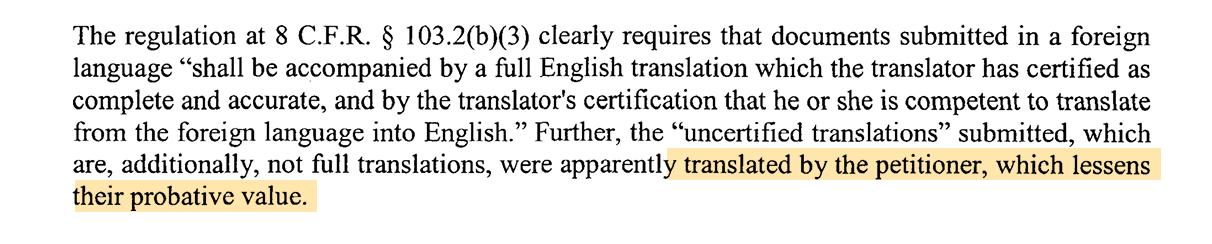
However, an AAO (Administrative Appeals Office) decision from 2009 recorded a precedent:
“The ‘uncertified translations’ submitted, which are, additionally, not full translations, were apparently translated by the petitioner, which lessens their probative value.”
Translation: “The submitted ‘uncertified translations’, which were also incomplete, were apparently translated by the petitioner, which reduces their probative value.”
What’s important to understand
In that AAO decision the problem was not self-translation per se, but the combination of three issues: (1) translations were uncertified (no translator oath), (2) translations were incomplete, and (3) they were translated by the petitioner. All three issues together gave the officer grounds to reduce the probative value.
In recent RFEs (2023–2025) we DO NOT see objections to self-translation. But people rarely sign the translator oath themselves — they usually ask a third party.
Practical advice: Translate as much as you can yourself — it saves time and money. But have the translator’s oath signed by a third person: a friend, neighbor, colleague, anyone fluent in both languages. It costs nothing, removes the only potential risk, and closes the issue once and for all. There will be enough risks in the petition without adding self-translation.
For English teachers: In your case self-translation is most likely to raise questions from an officer. If you teach English — find someone else to sign the oath. These are literally 2–3 cases out of 800+, but all involved English teachers.
What AAO is and why it matters
[details=“AAO (Administrative Appeals Office) — what it is and how it’s used in our knowledge base”]
AAO — the Administrative Appeals Office of USCIS, which reviews officers’ decisions for ~50 types of immigration benefits.
Types of AAO decisions
Precedent decisions — after approval by the Attorney General become binding authority for similar issues in the future. More: USCIS — precedent decisions
Adopted decisions — USCIS sometimes “adopts” a non-precedent decision as guidance for its employees (does not create externally binding precedent). More: USCIS — adopted decisions
Non-precedent decisions — link the law/policy to the facts of a specific case. They are binding only for the parties in that case and are not legal authority in other cases. But they are useful as guidance on “what may alarm an officer.”
Why we cite AAO
When we say “in AAO practice you can see…”, we rely on publicly available AAO decisions and official USCIS materials. They do not replace statutes/regulations but show real patterns of adjudicator reasoning — exactly what you need to understand how USCIS applies rules in practice.
More about AAO: USCIS — Administrative Appeals Office
5 translation mistakes that reduce evidentiary weight
Officers in RFEs explicitly state: "The submission of a single translation certification that does not specifically identify the document or documents it purportedly accompanies does not meet the requirements." Each document needs a separate certificate with the title.
If the translation is formatted with the same elements as the original document (same font, layout, logo), the officer may suspect that both documents were prepared by the same person. The translation should look like a SEPARATE document.
If you do translate yourself — be prepared that the probative value may be reduced. It’s better to have a third party sign the certificate.
The translator’s certificate must include a date. Absence of a date may raise questions about authenticity.
If you translate only part of a document — indicate this in the certificate. "Partial translation of [document name], pages X–Y" is acceptable. Simply omitting parts without notation is not.
What to check in a translation before filing
Even if you hired a translator, you must review the translation. In practice there are cases where a professional translator delivers work with gross errors — and the entire filing (hundreds of pages) becomes unusable. Here’s what to watch for:
Proper names and transliteration
The most common mistake. Proper names, surnames, organization names, and city names must be transliterated consistently ACROSS ALL documents. If the passport has "Evgenii" — all translations should use "Evgenii", not "Evgeniy" in one and "Eugene" in another. Different spellings of the same name = inconsistency in documents = grounds for an RFE.
Abbreviations
Do not transliterate — expand. An officer does not know what “OOO” or “OGRN” means.
| Incorrect | Correct |
|---|---|
| OOO | Limited Liability Company (LLC) |
| OGRN | Primary State Registration Number |
| INN | Taxpayer Identification Number |
| ZAO | Closed Joint-Stock Company |
| PAO | Public Joint-Stock Company |
| FGUP | Federal State Unitary Enterprise |
| IP | Individual Entrepreneur |
Seals and stamps
- If the seal is readable — translate the text on it
- If unreadable — write “Seal: Illegible” or “Stamp: Illegible”
- Describe state coats of arms in words: “Coat of Arms of the Russian Federation”
- DO NOT insert images of coats of arms and logos into the translation — only textual description (“Logo of [Organization Name]”)
Formatting consistency
- Use the same font style across translations
- Use a consistent date format (choose MM/DD/YYYY or DD Month YYYY and stick to it)
- Use the same transliteration for names
- Use the same translation for identical terms (don’t use “certificate” in one document and “diploma” in another for the same document)
Pre-filing checklist: Go through all translations and check: (1) the applicant’s name is spelled the same everywhere, (2) abbreviations are expanded, (3) each document has its own translator certificate, (4) the certificate contains the document title, date, and signature, (5) the translation is in proper English with no spelling mistakes.
Download: templates and tools
Three ready certificate examples: short format (most common), full format with document title (recommended), and minimal. Each uses fictitious names, signatures, and contacts — use as a template. On the second page — 8 formatting rules in Russian and a warning about self-translation.
A ready prompt for ChatGPT or Claude. Open the PDF, copy the prompt text, paste into an AI chat and attach a photo or screenshot of your translator certificate. The AI will check it against the 8 CFR 103.2(b)(3) requirements in 10 seconds — using a 7-point checklist — and tell you what to fix.
translator-cert-check-prompt.pdf (90.3 KB)
